

Solidity is a high‑level smart contract language that lets developers write Ethereum‑compatible code to automate decentralized applications.
Key Takeaways
- Definition: Solidity is the primary language for writing smart contracts on the Ethereum Virtual Machine.
- Core features: Statically typed, contract‑oriented, supports inheritance and libraries.
- Real‑world use: Powers DeFi platforms like Uniswap, NFTs like CryptoPunks, and enterprise solutions.
- Comparison: More blockchain‑specific than general‑purpose languages like JavaScript or Python.
- Risk warning: Bugs can lead to irreversible loss of funds; rigorous testing is mandatory.
What Is Solidity?
Solidity is the go‑to smart contract language for the Ethereum ecosystem.
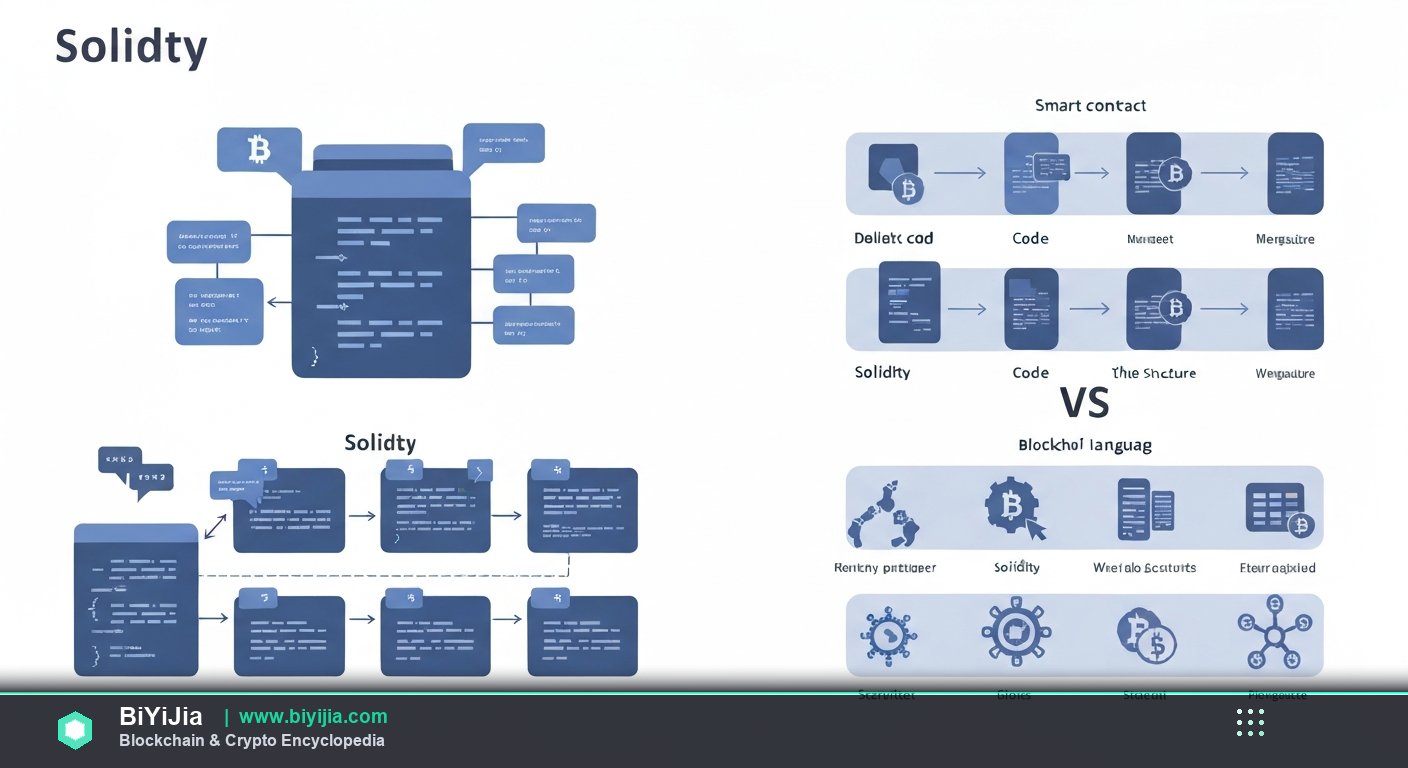
At its core, Solidity compiles human‑readable code into bytecode that runs on the Ethereum Virtual Machine (EVM), allowing deterministic execution across a distributed network. It blends concepts from C++, JavaScript, and Python, but adds blockchain‑specific constructs like address types, payable functions, and event logging.
Think of Solidity like the recipe book for a bakery that only uses digital ingredients; each recipe (contract) tells the oven (EVM) exactly how to bake a token, a loan, or a game item every time, with no room for improvisation.
How It Works
- Write the contract in Solidity syntax, defining state variables, functions, and events.
- Run the Solidity compiler (solc) to translate the source code into EVM bytecode and an Application Binary Interface (ABI).
- Deploy the bytecode to the Ethereum network; the network assigns a unique contract address.
- Users interact with the contract by sending transactions that invoke its functions, which the EVM executes deterministically.
- The EVM updates the contract’s state, emits events, and records the changes on the blockchain for anyone to verify.
Core Features
- Statically typed: Variables must be declared with a type, catching many bugs at compile time.
- Contract‑oriented: Code is organized into contracts that encapsulate state and behavior, mirroring real‑world agreements.
- Inheritance: Contracts can inherit from other contracts, enabling reusable libraries and modular design.
- Modifiers: Pre‑condition checks that run before function bodies, useful for access control.
- Events: Log entries that external applications can listen to, enabling off‑chain integrations.
- Assembly support: Inline assembly lets developers write low‑level EVM instructions for gas optimization.
Real‑World Applications
- Uniswap V4: Decentralized exchange built entirely in Solidity; over $10 B in cumulative trading volume in 2025 (Dune Analytics).
- OpenSea: NFT marketplace whose core escrow contracts are written in Solidity, handling more than 8 million NFTs minted to date.
- Aave: Lending protocol that uses Solidity contracts to manage collateralized loans, with $15 B locked in 2025.
- Chainlink: Oracle network contracts written in Solidity that feed off‑chain data to DeFi apps, powering over 1,200 data feeds.
- Polygon Bridge: Cross‑chain bridge contracts that move assets between Ethereum and Polygon, processing $3 B in transfers each month.
Comparison with Related Concepts
Solidity vs Vyper: Solidity offers a richer syntax and broader library support, while Vyper emphasizes simplicity and auditability by restricting complex features.
Solidity vs Traditional Programming: Unlike JavaScript or Python, Solidity runs on a deterministic virtual machine, has immutable deployment, and must manage gas costs for every operation.
Solidity vs Ethereum: Ethereum is the blockchain platform; Solidity is the language you use to write the code that lives on that platform.
Risks & Considerations
- Reentrancy attacks: Malicious contracts can call back into a vulnerable contract before state changes are finalized, draining funds.
- Integer overflow/underflow: Prior to Solidity 0.8, unchecked arithmetic could wrap around; modern versions include built‑in safety checks.
- Gas inefficiency: Poorly written loops or storage operations can make transactions prohibitively expensive.
- Immutable bugs: Once deployed, a contract cannot be patched; developers must use upgrade patterns or proxy contracts.
- Complexity creep: Over‑engineered contracts become hard to audit, increasing the chance of hidden vulnerabilities.
Embedded Key Data
According to Dune Analytics, Solidity contracts accounted for 96% of all bytecode deployed on Ethereum in 2025, underscoring its dominance as the smart contract language of choice.
In 2024, the average gas cost per Solidity function call decreased by 12% after the Istanbul hard fork introduced opcode optimizations (Ethereum Foundation report).
Frequently Asked Questions
What is Solidity used for?
Solidity is used to write smart contracts that automate agreements on Ethereum and compatible chains. From token standards like ERC‑20 to complex DeFi protocols, Solidity powers the code that enforces trustless interactions.
Do I need to know other programming languages to learn Solidity?
Having experience with JavaScript, C++, or Python helps because Solidity borrows syntax from those languages. However, beginners can start directly with Solidity tutorials that focus on blockchain concepts.
Can Solidity be used on blockchains other than Ethereum?
Yes. Blockchains that implement the Ethereum Virtual Machine—such as Binance Smart Chain, Polygon, Avalanche C‑Chain, and Fantom—accept Solidity bytecode, making the language portable across many ecosystems.
How secure is Solidity code?
Security depends on the developer. Solidity provides safety features like overflow checks, but bugs like reentrancy still arise. Audits, formal verification, and using battle‑tested libraries are essential to mitigate risk.
What resources are best for learning Solidity in 2026?
Official Solidity documentation, interactive tutorials on Remix, and courses on platforms like Coursera and Udemy are solid starting points. Joining community forums and analyzing open‑source contracts on GitHub also accelerates learning.
Summary
Solidity is the cornerstone smart contract language that enables developers to build decentralized applications on Ethereum and EVM‑compatible chains. Mastering Solidity opens doors to DeFi, NFTs, and the broader blockchain economy, while demanding careful attention to security and gas efficiency. For deeper insight, explore related concepts like Ethereum, Smart Contract, Programming, and the EVM.