
Key Takeaways
- Block Confirmation is the validation step that turns a pending transaction into a secured record on the blockchain.
- Each new block adds a Confirmation Count, increasing the security and irreversibility of earlier transactions.
- In practice, crypto wallets and exchanges wait for a specific number of confirmations before releasing funds.
- Compared to traditional banking clears, block confirmations are decentralized, transparent, and resistant to single-point failure.
- Rushing a transaction without enough confirmations can expose users to double‑spend attacks and lost funds.
Decentralized Finance (DeFi) platforms rely heavily on block confirmations to guarantee that asset transfers are final and tamper‑proof.
What Is Block Confirmation?
Block Confirmation is the process that tells you a transaction has been recorded on the blockchain and is now considered final.
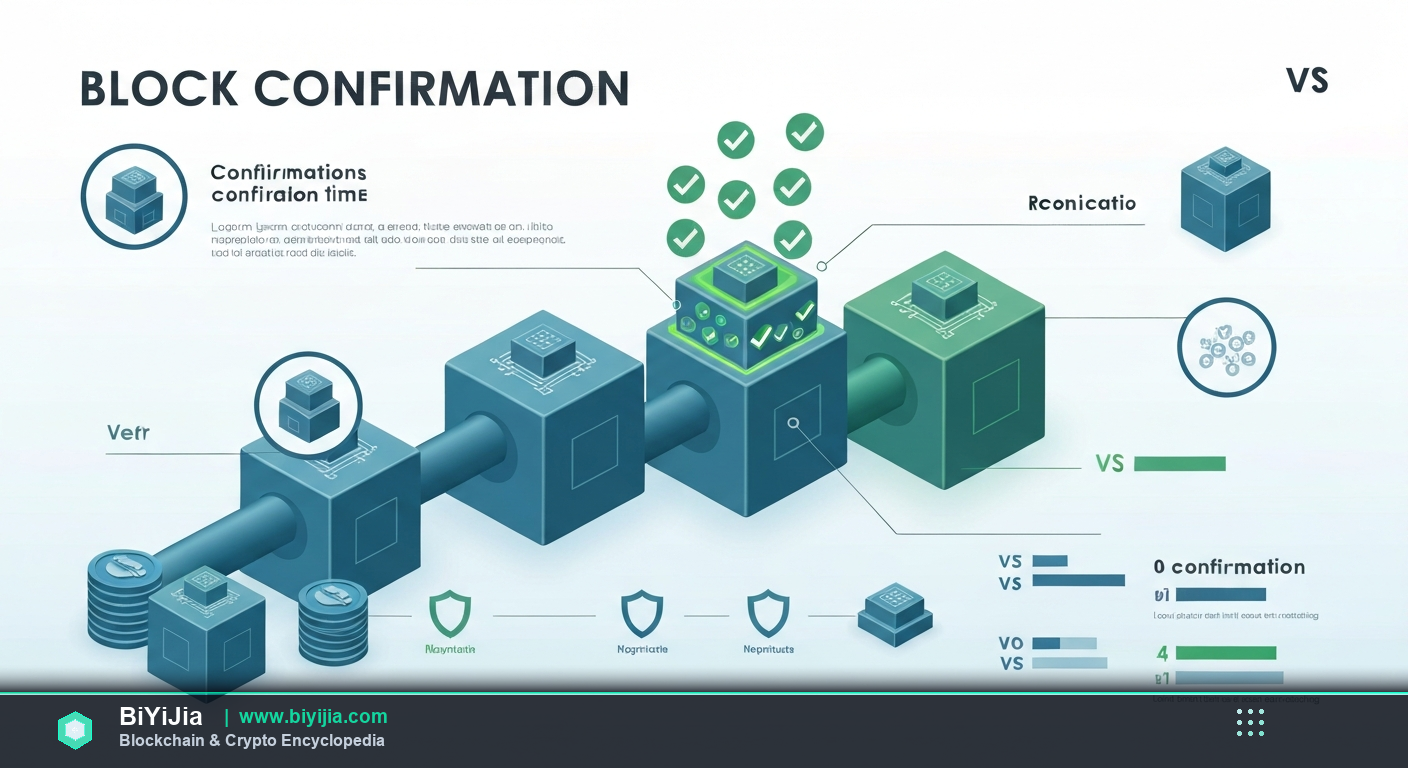
When a miner or validator successfully creates a new block, that block is broadcast to the network. Other nodes then verify the block’s integrity, and each subsequent block that builds on top of it adds another layer of confidence. In simple terms, the more blocks that follow, the harder it becomes to rewrite history, which is why we talk about a "confirmation count" rather than a single event.
Think of a block confirmation like a notary public stamping a document and then having multiple witnesses sign an additional page. The original notarization is still there, but each new signature makes it increasingly difficult for anyone to dispute the document’s authenticity.
How It Works
- Transaction Broadcast: A user sends a transaction to the network; nodes place it in a mempool awaiting inclusion.
- Block Creation: A miner (or validator) selects transactions, solves the consensus puzzle, and creates a new block containing the transaction.
- Network Validation: Other nodes verify the block’s proof‑of‑work (or proof‑of‑stake) and ensure all transactions follow protocol rules.
- Chain Extension: Subsequent blocks are mined on top of the confirmed block, each adding one to the Confirmation Count.
- Finality Threshold: Wallets, exchanges, and smart contracts wait for a pre‑defined number of confirmations before considering the transaction immutable.
Core Features
- Confirmation Count: The numeric tally of how many blocks have built on top of the one that contains your transaction.
- Security Increment: Each additional block exponentially raises the computational effort required to rewrite history.
- Irreversibility: After a sufficient number of confirmations, the transaction is effectively permanent.
- Wait Time: The real‑world delay between broadcast and finality, varying by blockchain and network congestion.
- Consensus Dependence: Confirmation rules differ between Proof‑of‑Work, Proof‑of‑Stake, and hybrid systems.
- Risk Mitigation: Platforms use confirmation thresholds to protect against double‑spend attacks and chain reorganizations.
Real‑World Applications
- Bitcoin – Most exchanges require 6 confirmations (≈1 hour) before crediting a deposit.
- Ethereum – DeFi protocols often settle after 12–15 confirmations, roughly 3–5 minutes, to balance speed and security.
- Litecoin – Known for faster block times; many services accept 3 confirmations (≈7.5 minutes) as sufficient.
- Ripple (XRP Ledger) – Uses a unique consensus algorithm; typical finality occurs after 1–2 seconds with a default of 5 validated ledger changes.
Comparison with Related Concepts
Confirmation Count vs Confirmation Time: Confirmation Count measures how many blocks have followed, while Confirmation Time is the wall‑clock duration it takes to reach that count. A high count with slow block times can still mean a long wait.
Block Confirmation vs Transaction Confirmation: Transaction confirmation refers to the moment a specific transaction is included in a block, whereas block confirmation is the broader process of the block itself gaining subsequent blocks.
Crypto Confirmation vs Traditional Settlement: Traditional banking settlements rely on centralized ledgers and clearinghouses; crypto confirmation is decentralized, trustless, and visible to anyone.
Risks & Considerations
- Double‑Spend Attack: Insufficient confirmations can allow an attacker to broadcast a conflicting transaction that later overtakes the original.
- Chain Reorganization: In rare cases, a longer fork can replace the current chain, invalidating recent confirmations.
- Network Congestion: High transaction volume can dramatically increase wait time, causing users to underestimate required confirmations.
- Variable Security Across Chains: A 3‑confirmation rule on Bitcoin is far more secure than 3 confirmations on a low‑hashrate altcoin.
- Human Error: Setting too low a confirmation threshold in smart contracts can expose funds to theft.
Embedded Key Data
According to the 2025 Blockchain Metrics Report by Chainalysis, 92% of Bitcoin transactions achieve six confirmations within 60 minutes, up from 78% in 2022.
Ethereum’s average block time in Q4 2025 was 12.3 seconds, meaning a 15‑confirmation finality window translates to roughly 3 minutes, which has enabled DeFi platforms to settle trades in near‑real‑time.
Frequently Asked Questions
What is block confirmation and why does it matter?
Block confirmation is the process by which a newly added block gains additional blocks on top of it, solidifying the transactions it contains. It matters because each new block makes it exponentially harder to alter the history, ensuring that funds cannot be double‑spent or reversed.
How many confirmations should I wait for before trusting a transaction?
The safe number varies by blockchain. For Bitcoin, most services use six confirmations. Ethereum‑based DeFi often settles after 12‑15 confirmations. Smaller or faster chains may accept fewer, but always check the platform’s policy.
Can a transaction be reversed after it’s confirmed?
In theory, a deep chain reorganization could roll back a transaction, but the probability drops dramatically with each added confirmation. After six Bitcoin confirmations, the odds are astronomically low—practically zero for everyday users.
What is the difference between transaction confirmation and crypto confirmation?
Transaction confirmation refers to the inclusion of a specific transaction in a block. Crypto confirmation is a broader term that encompasses the entire process of that block gaining subsequent blocks, thus confirming the transaction and the block itself.
Do all blockchains use the same confirmation rules?
No. Proof‑of‑Work chains like Bitcoin rely on block height, while Proof‑of‑Stake networks such as Cardano use epoch‑based finality. Each protocol defines its own thresholds for what constitutes a secure confirmation.
Summary
Block Confirmation is the backbone of blockchain security, turning a tentative transaction into an immutable record through successive blocks. Understanding confirmation counts, wait times, and associated risks helps users and developers protect assets and design reliable smart contracts. Explore related concepts like Confirmation Count, Security, Irreversibility, and Wait Time for a fuller picture.