
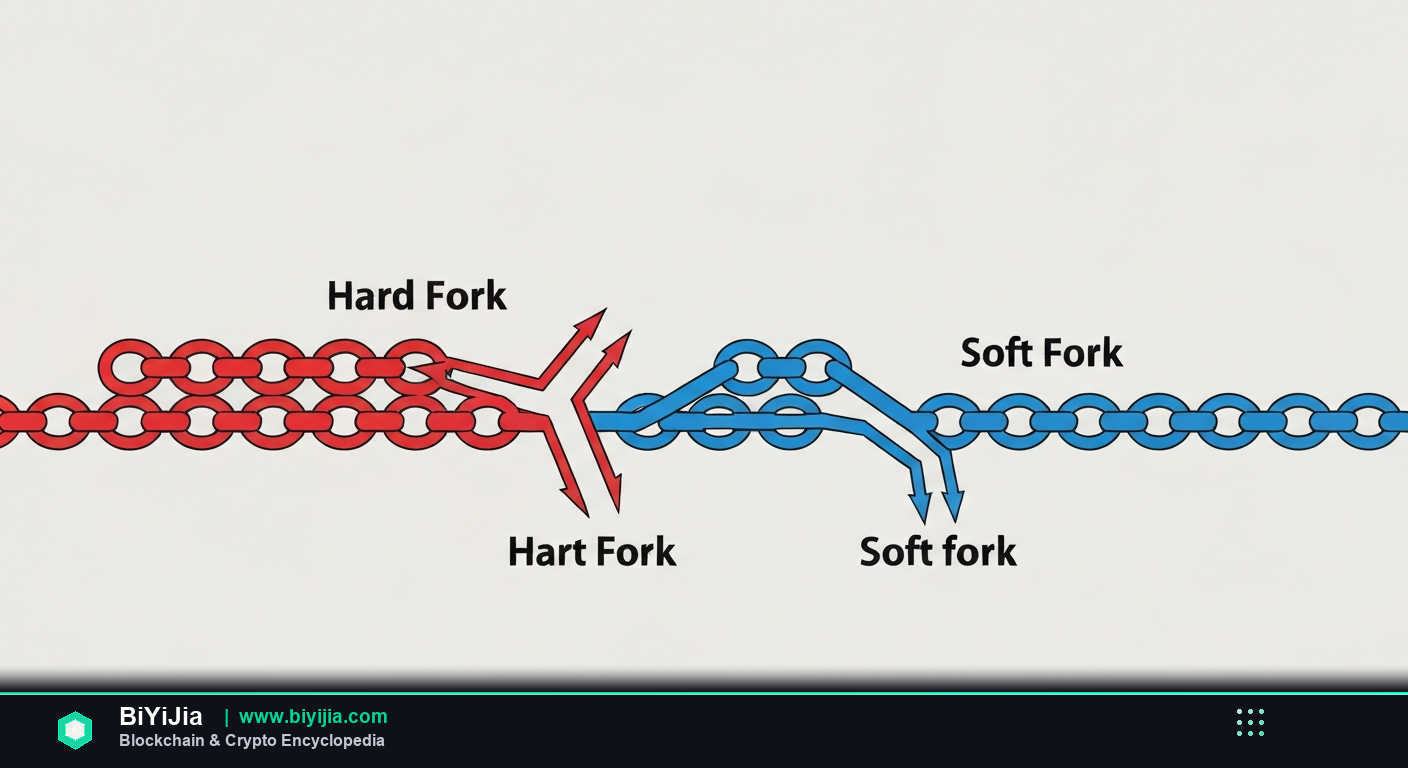
Fork refers to a change in a blockchain's protocol that creates a new version of the ledger, sometimes splitting the network into separate chains.
Key Takeaways
- A fork is a protocol upgrade that may result in one or multiple blockchains.
- Hard forks are non‑compatible changes; soft forks retain backward compatibility.
- Major crypto forks include Bitcoin Cash (BCH) and Ethereum's London upgrade.
- Compared to traditional software patches, forks can cause community splits and market volatility.
- Investors should watch for token swaps, liquidity risks, and regulatory scrutiny.
What Is Fork?
In plain language, a fork is a change to a blockchain's set of rules that creates a new version of the ledger.
Technically, a fork modifies the consensus protocol – the algorithm that tells nodes which blocks are valid. When the code diverges, nodes decide whether to follow the old rule set or adopt the new one. If the change is backward compatible, it's called a soft fork; if not, it's a hard fork, which forces everyone onto the new chain or creates a split.
Think of a fork like a road sign that tells drivers to take a new route. Some drivers follow the new sign, while others stick to the old road, leading to two parallel paths.
How It Works
- Developers propose a protocol change and publish the new code on a public repository.
- Node operators review the code, test it on testnets, and signal support by upgrading their software.
- When a predefined block height or timestamp is reached, the network checks which version each node runs.
- If the majority adopt the new rules, the chain continues as a single upgraded network (soft fork). If the new rules are incompatible, the chain splits into two independent ledgers (hard fork).
- Tokens on the original chain are duplicated on the new chain, allowing users to claim assets on both sides, if a split occurs.
Core Features
- Protocol Change: Alters consensus rules, transaction formats, or block validation criteria.
- Backward Compatibility: Determines whether older nodes can still validate new blocks (soft fork) or must upgrade (hard fork).
- Community Governance: Fork decisions often involve voting, miner signaling, or developer consensus.
- Token Duplication: In a hard fork, the original token appears on both chains, creating parallel assets.
- Network Upgrade: Forks are the primary mechanism for scaling, adding features, or fixing critical bugs.
- Risk Profile: Forks can cause price swings, liquidity fragmentation, and regulatory attention.
Real-World Applications
- Bitcoin Cash (BCH): A hard fork of Bitcoin in 2017 that increased block size to 8 MB, aiming for faster transactions. By 2026 BCH processes over 2 million daily transactions (CoinMetrics).
- Ethereum London Upgrade: A soft fork in 2021 that introduced EIP‑1559, changing fee dynamics and burning ~1.5 % of ETH supply annually (The Block).
- Polygon (MATIC) Upgrade: A series of soft forks that added zk‑rollup support, boosting throughput to over 65,000 TPS in test environments (Polygon Reports).
- Decred (DCR) Hard Fork 2023: Implemented a new governance model, allowing stakeholders to vote on protocol changes directly on-chain.
- Solana's 2024 Soft Fork: Added native support for Decentralized Finance (DeFi) primitives, reducing transaction latency by 20 % (Solana Foundation).
Comparison with Related Concepts
Fork vs Blockchain Upgrade: A fork is the mechanism; a blockchain upgrade is the outcome. All upgrades happen via forks, but not every fork results in a meaningful upgrade.
Hard Fork vs Soft Fork: Hard forks break compatibility, creating a new chain (e.g., Bitcoin Cash). Soft forks keep older nodes functional, maintaining a single chain (e.g., Ethereum London).
Fork vs Community Split: A community split describes the social fallout when participants disagree on a fork. The technical split is the fork itself; the human split can affect token price and ecosystem health.
Fork vs Protocol Change: Protocol change is the abstract set of rule modifications; a fork is the concrete event that enforces those changes on the network.
Risks & Considerations
- Market Volatility: Fork announcements often trigger price spikes or crashes as traders speculate on new token value.
- Liquidity Fragmentation: When a chain splits, liquidity can be divided between the original and new token, reducing depth on exchanges.
- Security Risks: New code may contain bugs or vulnerabilities that attackers can exploit before audits are complete.
- Regulatory Uncertainty: Some jurisdictions treat forked tokens as new securities, exposing holders to compliance risk.
- Technical Complexity: Users must manage private keys on multiple chains, increasing the chance of loss or misconfiguration.
According to a 2025 study by Messari, 42 % of hard forks resulted in a token price decline of more than 15 % within the first month (Messari Report).
Data from Glassnode shows that soft forks that include fee‑burn mechanisms have reduced average transaction fees by roughly 30 % across the Ethereum network since 2021 (Glassnode, 2026).
Frequently Asked Questions
What is the difference between a hard fork and a soft fork?
A hard fork introduces changes that are not compatible with the old software, forcing all nodes to upgrade or creating a new chain. A soft fork makes changes that older nodes can still recognize as valid, so the network stays unified.
Do I need to do anything when a fork happens?
If you hold tokens on an exchange, the platform usually handles the token split automatically. If you control your own wallet, you’ll need to upgrade the software or claim the new tokens using the appropriate claim process.
Why do developers create forks instead of just updating the protocol?
Because blockchain consensus is decentralized, any change must be accepted by a majority of participants. Forks provide a clear, on‑chain decision point that lets the community vote with their software.
Can a fork be reversed?
Technically, once a block is mined and accepted under the new rules, it cannot be undone without a massive coordinated effort, which would be considered a 51 % attack. Reversals are therefore practically impossible.
How does a fork affect DeFi (Decentralized Finance) applications?
DeFi protocols rely on the underlying blockchain’s rules. A fork that changes gas fees, block times, or token standards can require smart contracts to be redeployed or upgraded, potentially disrupting services temporarily.
Is a fork always a bad sign for investors?
Not necessarily. Some forks, like Ethereum’s London upgrade, brought long‑term benefits such as fee predictability. However, each fork carries its own risk profile, so thorough research is essential.
Summary
Forks are the engine that drives blockchain evolution, allowing communities to adopt new features, fix bugs, or pursue divergent visions. Understanding hard vs soft forks, the associated risks, and real‑world examples like Bitcoin Cash and Ethereum upgrades equips you to navigate the ever‑changing crypto landscape. For deeper insight, explore related concepts such as Blockchain Upgrade, Community Split, and Protocol Change.