

TPS (Transactions Per Second) is the headline metric that tells you how fast a blockchain can move value, data, or smart‑contract calls from point A to point B.
Key Takeaways
- Definition: TPS measures how many transactions a blockchain can confirm each second.
- Core feature: It reflects network throughput, latency, and consensus efficiency.
- Real‑world use: High‑TPS chains power DeFi (Decentralized Finance (DeFi)) apps, NFT marketplaces, and gaming platforms.
- Traditional comparison: Visa processes roughly 1,700 TPS on average, peaking over 65,000 during spikes.
- Risk warning: Pushing for higher TPS can compromise security or decentralization if not designed carefully.
What Is TPS (Transactions Per Second)?
In plain language, TPS tells you how many transactions a blockchain can settle in a single second.
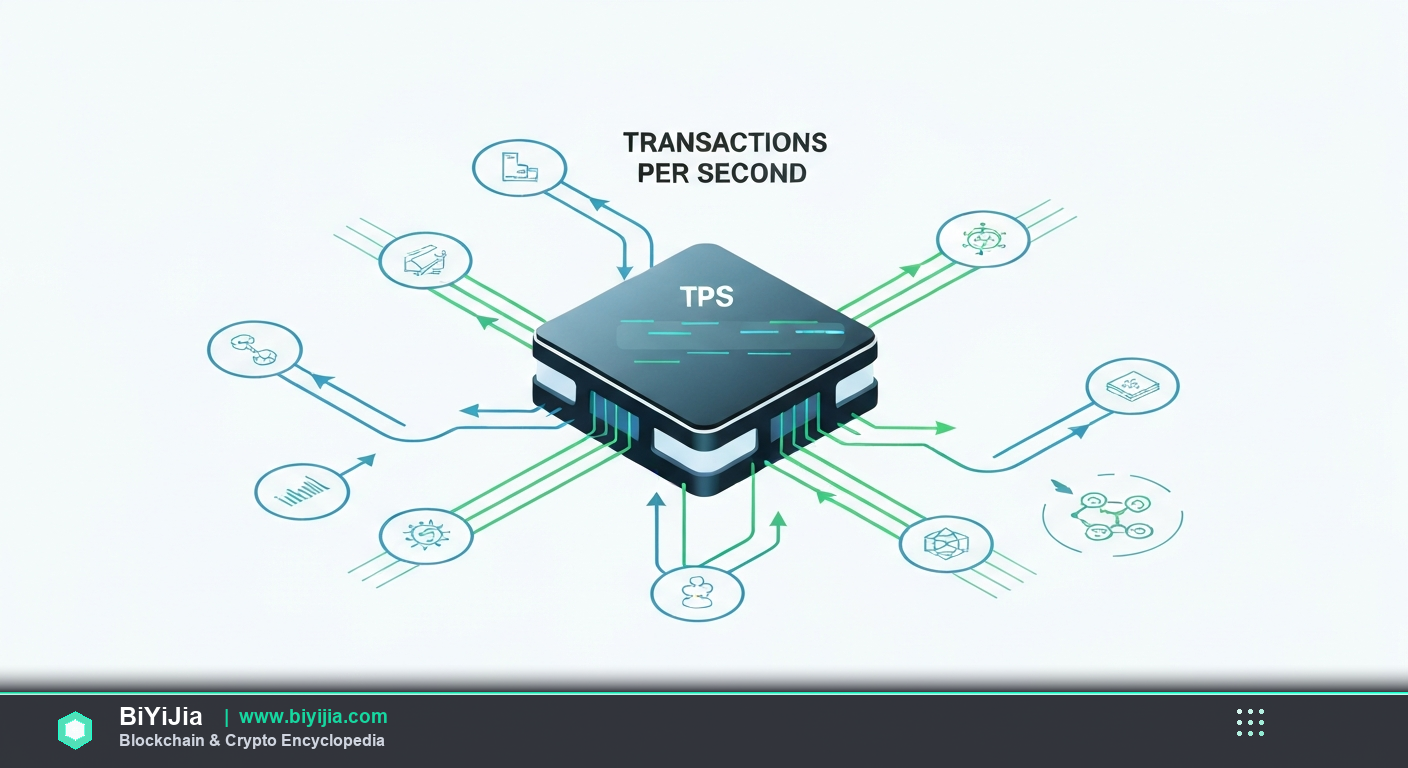
Under the hood, TPS depends on how quickly nodes can reach consensus, how large each block is, and how efficiently the protocol handles data sharding or parallel execution. The metric bundles together latency (how fast a single transaction is confirmed) and throughput (how many can be confirmed together).
Think of TPS like the lanes on a highway: a single‑lane road lets a few cars pass per minute, while a multi‑lane superhighway lets thousands zip by, reducing traffic jams and getting you to your destination faster.
How It Works
- Transaction creation: Users broadcast signed transactions to the network.
- Propagation and mempool: Nodes share these transactions, storing them temporarily in a mempool.
- Block assembly: Validators or miners gather a batch of transactions, respecting block size limits.
- Consensus round: The network runs its consensus algorithm (Proof‑of‑Work, Proof‑of‑Stake, or newer BFT variants) to agree on the new block.
- Finality: Once the block is committed, all included transactions are considered final, contributing to the TPS count.
Core Features
- Throughput: The raw number of transactions processed per second, often boosted by larger block sizes or parallel execution.
- Latency: The time from transaction submission to final confirmation; low latency improves user experience.
- Scalability: The ability to increase TPS as demand grows, typically via Layer‑2 solutions, sharding, or optimized consensus.
- Security trade‑offs: Higher TPS can sometimes mean reduced decentralization or weaker attack resistance if not engineered properly.
- Economic impact: TPS influences transaction fees; higher capacity often drives fees down in competitive ecosystems.
Real-World Applications
- Solana: Claims up to 65,000 TPS thanks to its Proof‑of‑History ordering and parallel runtime, powering high‑frequency DeFi and NFT projects.
- Polygon (zkEVM): Achieves around 4,000 TPS on its Layer‑2 rollup, enabling cheap, fast payments for gaming and micro‑transactions.
- Algorand: Consistently delivers ~1,000 TPS with sub‑second finality, making it a favorite for stablecoin issuers.
- Arbitrum: An optimistic rollup that pushes Ethereum’s native ~15 TPS to roughly 2,000 TPS for DeFi protocols.
- Ripple (XRP Ledger): Processes about 1,500 TPS, focusing on cross‑border payments and banking integration.
Comparison with Related Concepts
TPS vs Scaling: Scaling is the broader set of techniques (sharding, Layer‑2, sidechains) aimed at increasing TPS, while TPS is the actual performance metric you see on‑chain.
TPS vs Visa Comparison: Visa averages 1,700 TPS, peaks over 65,000 during holidays. Some blockchains like Solana claim similar peak numbers, but Visa’s network benefits from mature fraud‑prevention and centralized control.
TPS vs Throughput: Throughput describes the total data processed (bytes per second), whereas TPS counts discrete transaction units, which may vary in size.
Risks & Considerations
- Security dilution: Aggressive TPS boosts can reduce the number of validators per shard, making attacks easier.
- Centralization pressure: High‑TPS chains sometimes require powerful hardware, pushing out smaller operators.
- Economic volatility: Sudden TPS spikes can cause fee market instability, leading to unpredictable costs for users.
- Network congestion: If demand exceeds capacity, transaction queues grow, raising latency and potentially causing chain stalls.
- Technology obsolescence: Protocols built around a fixed TPS may struggle to adapt to future scaling breakthroughs.
Embedded Key Data
According to a 2025 Chainalysis report, the average blockchain TPS across the top 20 networks rose from 250 in 2022 to 1,200 in 2025, reflecting rapid adoption of Layer‑2 solutions.
Visa’s 2024 financial statements show a sustained average of 1,700 TPS, with a record 65,000 TPS during the U.S. holiday shopping season, setting a high benchmark for traditional payment rails.
Frequently Asked Questions
What does TPS actually measure?
TPS quantifies the number of transactions a blockchain can finalize per second. It combines block size, block time, and consensus efficiency into a single performance figure that users and developers use to gauge network speed.
Why is TPS important for DeFi?
DeFi protocols require fast, cheap confirmations to execute trades, liquidations, and yield‑earning actions. Higher TPS reduces latency and fee pressure, making decentralized exchanges and lending platforms more competitive with centralized alternatives.
Can a blockchain have unlimited TPS?
In theory, scaling techniques like sharding, rollups, and state channels can push TPS very high, but practical limits arise from hardware, network bandwidth, and the need to keep nodes decentralized. Unlimited TPS would likely sacrifice security or decentralization.
How does Solana achieve its high TPS claim?
Solana couples Proof‑of‑History (a cryptographic timestamp) with a highly parallel runtime, allowing multiple transaction streams to be processed simultaneously. This architecture lets it hit 65,000 TPS in test environments, though real‑world usage often settles lower.
Is a higher TPS always better?
Not necessarily. A network must balance speed with security, decentralization, and cost. Some niche applications value ultra‑low latency over raw throughput, while others prioritize a robust validator set over peak TPS.
How does Layer‑2 affect TPS?
Layer‑2 solutions bundle many off‑chain transactions into a single on‑chain proof, effectively multiplying the base chain’s TPS. For example, Optimistic rollups can deliver several thousand TPS on top of Ethereum’s ~15 native TPS.
Summary
TPS (Transactions Per Second) captures how quickly a blockchain can confirm activity, a cornerstone metric for scalability, user experience, and economic viability. Understanding TPS helps you compare blockchain networks, assess their suitability for DeFi, gaming, or payments, and spot trade‑offs between speed, security, and decentralization.