
Key Takeaways
- Definition: USDT (Tether) is a dollar‑pegged stablecoin backed by reserves.
- Core features: High liquidity, blockchain‑agnostic, near‑instant settlement.
- Real‑world use: Powers cross‑border payments, crypto‑exchange trading pairs, and DeFi collateral.
- Traditional comparison: Functions like a digital cash equivalent of the US dollar, but on-chain.
- Risk warning: Reserve transparency and regulatory scrutiny remain ongoing concerns.
What Is USDT (Tether)?
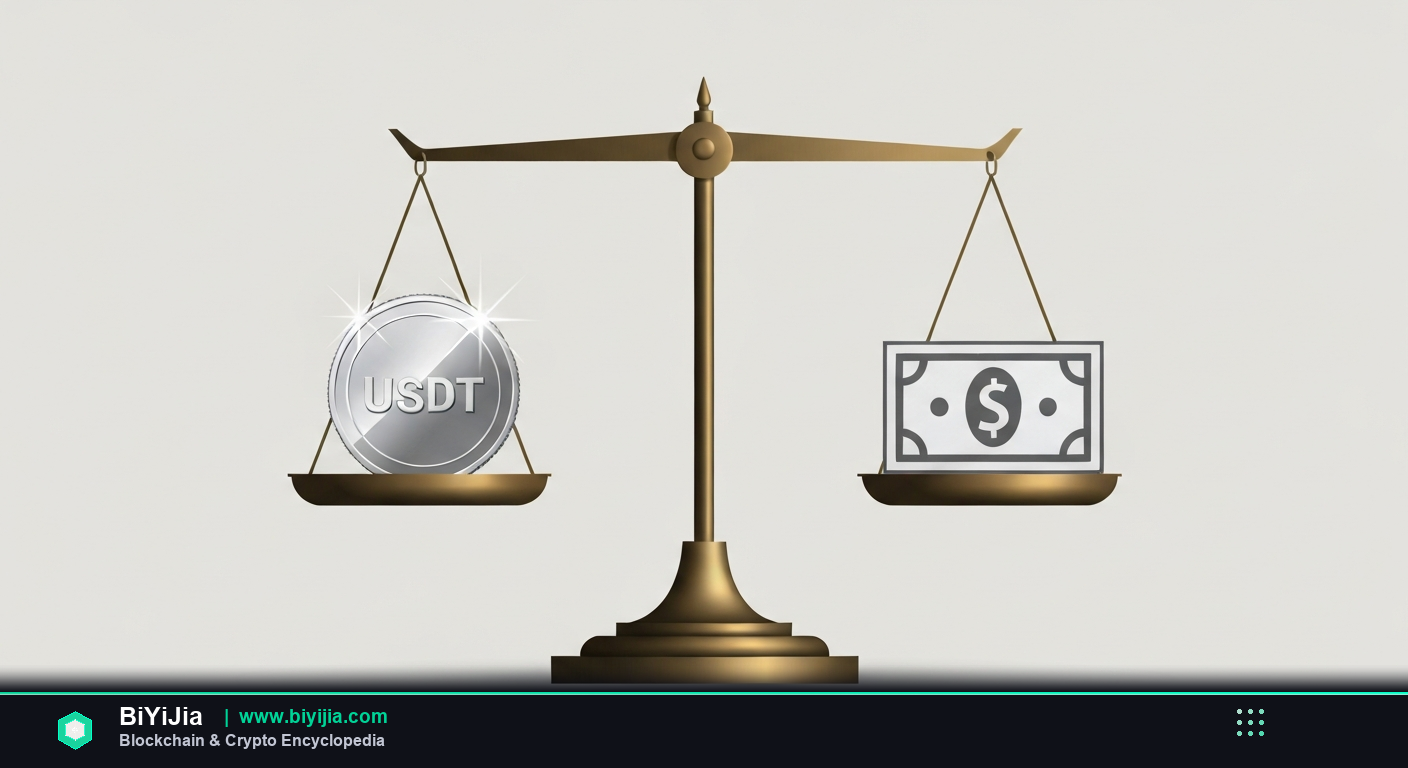
USDT (Tether) is a stablecoin that strives to maintain a 1:1 peg to the US dollar.
Technically, every USDT token is issued when Tether Ltd. claims to have an equivalent amount of fiat or cash‑equivalent assets in reserve; the blockchain records the issuance and redemption events, enabling anyone to verify supply but not the underlying audit.
Think of USDT as a digital version of a dollar bill you keep in a locked box: you can move it around the world instantly, but its value stays tied to the physical dollar you left behind.
How It Works
- Someone sends US dollars to Tether Ltd. via a bank transfer.
- Tether creates an equivalent amount of USDT on a chosen blockchain (Ethereum, Tron, Solana, etc.).
- The newly minted USDT is sent to the sender’s wallet, ready for on‑chain use.
- If a holder wants to cash out, they submit a redemption request; Tether burns the USDT and returns the fiat to the user’s bank account.
- All issuance and redemption events are logged on‑chain, providing transparency of token supply.
Core Features
1:1 Dollar Peg: Each USDT is supposedly backed by one US dollar or equivalent asset, keeping price volatility low.
Multi‑Chain Support: Available on more than a dozen blockchains, from Ethereum (ERC‑20) to Tron (TRC‑20) and newer Layer‑2 solutions.
High Liquidity: USDT consistently ranks among the top‑traded crypto assets, ensuring tight spreads on exchanges.
Fast Settlement: Transactions settle in seconds, making it ideal for arbitrage and rapid payments.
Regulatory Adaptation: Tether has begun publishing periodic attestations to address reserve‑verification concerns.
DeFi Compatibility: Used as collateral in lending protocols, yield farms, and liquidity pools across the [internal link: Decentralized Finance (DeFi)] ecosystem.
Real‑World Applications
- Binance: Offers USDT trading pairs for over 500 cryptocurrencies, handling daily volumes exceeding $30 billion (2025 data).
- Coinbase: Allows USDT deposits and withdrawals, providing a bridge for fiat‑on‑ramp users.
- Aave: Accepts USDT as collateral for borrowing other assets, with a utilization rate of around 45 % in Q4 2025.
- Remitly: Uses USDT for cross‑border remittances, cutting transaction times from days to minutes.
- OpenSea: Enables creators to price NFTs in USDT, stabilizing revenue for artists in volatile markets.
Comparison with Related Concepts
USDT vs USDC: USDT has broader blockchain coverage and higher daily volume, but USDC is generally regarded as having stricter reserve audits.
USDT vs Fiat‑Pegged Stablecoin: USDT is a specific example of a fiat‑pegged stablecoin; other examples include USDC, BUSD, and DAI, each differing in governance and collateral transparency.
USDT vs Traditional Money: Unlike physical cash, USDT can be transferred globally without intermediaries, yet it still relies on a central issuer for reserve backing.
Risks & Considerations
Reserve Transparency: Critics argue that Tether’s audits are infrequent, making it hard to verify full backing.
Regulatory Scrutiny: Multiple jurisdictions have investigated Tether for potential misrepresentation of reserves.
Counterparty Risk: As a centrally issued token, users depend on Tether Ltd.’s solvency and operational integrity.
Blockchain Congestion: On heavily used chains like Ethereum, high gas fees can erode the cost advantage of USDT transfers.
Legal Jurisdiction: Different countries may treat USDT differently for tax and AML purposes, creating compliance complexity.
Embedded Key Data
According to the Tether Transparency Report Q2 2025, the company held $85 billion in reserves covering the circulating supply of USDT, representing a 95 % reserve coverage ratio.
Data from CoinMarketCap shows that USDT consistently captures around 45 % of the total stablecoin market cap as of December 2025, making it the dominant dollar‑pegged asset.
Frequently Asked Questions
What is USDT used for?
USDT serves as a digital dollar for trading, payments, and DeFi collateral. Its stable value lets traders move in and out of volatile assets without converting back to fiat, and businesses use it for fast, low‑cost cross‑border settlements.
How does Tether prove its reserves?
Tether publishes periodic attestations from third‑party accounting firms. While these reports confirm the total amount of assets held, they do not provide a real‑time, itemized ledger of every dollar, which is why some users still demand more granular audits.
Can I hold USDT on a hardware wallet?
Yes. Since USDT exists as an ERC‑20, TRC‑20, or similar token, you can store it on any hardware wallet that supports the relevant blockchain, such as Ledger or Trezor, keeping your private keys offline.
Is USDT safe for long‑term storage?
Safety depends on your risk tolerance. The token’s peg and liquidity are strong, but central‑issuer risk and regulatory uncertainty mean many advisors recommend diversifying across multiple stablecoins for long‑term holdings.
How does USDT differ from other stablecoins like DAI?
USDT is fiat‑backed, meaning each token is claimed to be backed by a dollar in reserve. DAI, on the other hand, is crypto‑collateralized and governed by the MakerDAO protocol, which introduces different risk profiles and decentralization levels.
Summary
USDT (Tether) is the most widely used dollar‑pegged stablecoin, offering high liquidity and cross‑chain flexibility for traders, developers, and businesses. Understanding its mechanics, benefits, and risks helps you navigate the broader stablecoin landscape, including related concepts like [internal link: Stablecoin], [internal link: Fiat-Pegged], and [internal link: USDC].