

Key Takeaways
- Definition: A Merkle tree (also called a hash tree) is a binary tree of cryptographic hashes that lets you prove data integrity with minimal data.
- Core feature: It provides logarithmic proof size, making verification fast and bandwidth‑efficient.
- Real‑world use: Blockchains, Decentralized Finance (DeFi) protocols, and distributed file systems rely on Merkle trees for consensus and storage.
- Compared to traditional lists: Merkle trees replace linear scans with constant‑time proofs, cutting verification cost dramatically.
- Risk note: Incorrect implementation can expose the system to collision attacks or malformed proofs.
What Is Merkle Tree?
In plain English, a Merkle tree is a way to bundle many pieces of data into a single short fingerprint that anyone can verify.
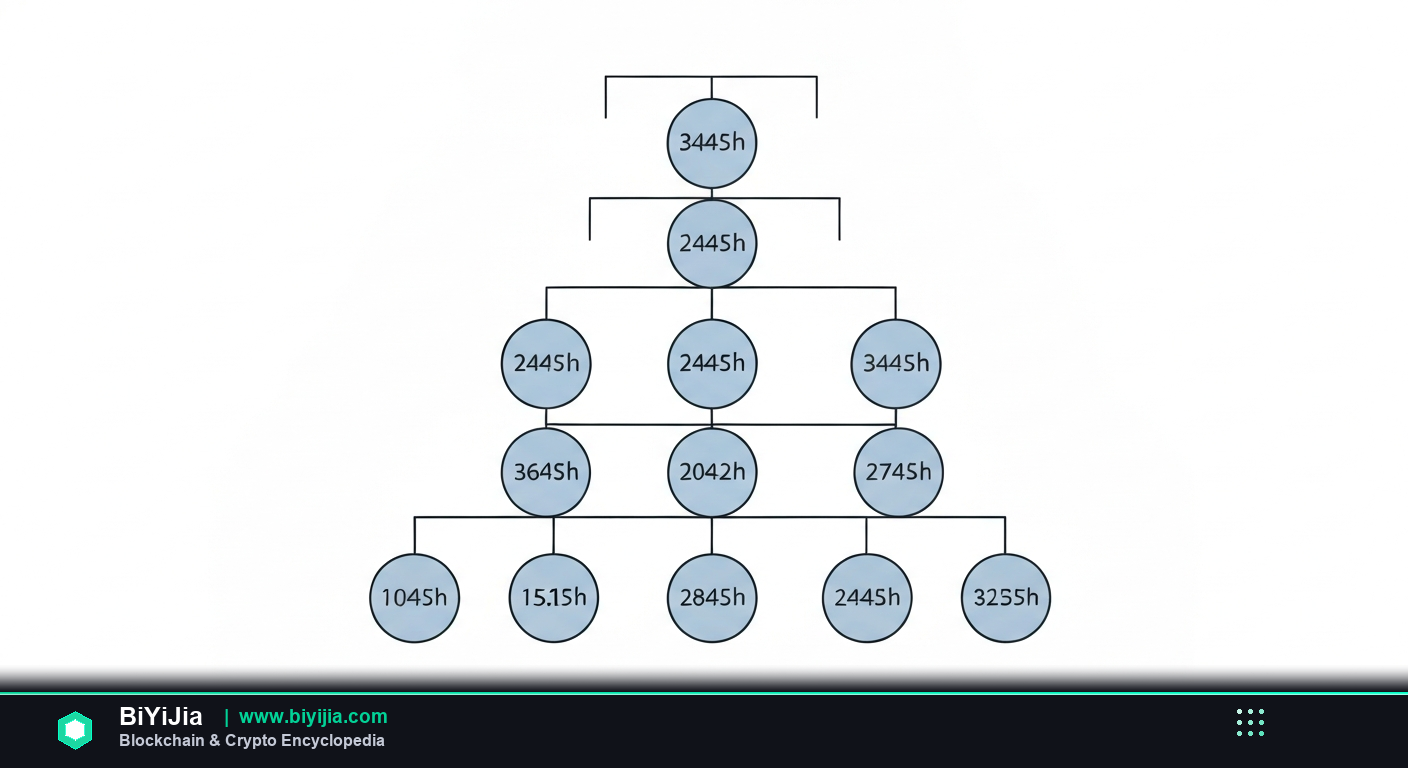
Technically, the structure builds a binary tree where each leaf holds the hash of a data chunk, and each parent node stores the hash of its two children. By repeatedly hashing pairs of hashes up to the root, you end up with a single root hash that uniquely represents the entire dataset. If any leaf changes, the root changes, and the discrepancy is instantly detectable.
Think of it like a family tree where each parent’s name is derived from the names of their children. You can prove a grandchild’s identity by showing a short chain of parent names instead of the whole lineage.
How It Works
- Split the data into equal‑sized blocks and hash each block individually.
- Pair up adjacent hashes; if there’s an odd number, duplicate the last hash to keep the tree balanced.
- Hash each pair together to form the next level of nodes.
- Repeat the pairing‑and‑hashing process until a single hash—called the Merkle root—remains.
- To verify a single block, provide the block’s hash plus the sibling hashes along the path to the root; the verifier recomputes the root and checks it against the known value.
Core Features
- Logarithmic Proof Size: Verification requires only O(log n) hashes, regardless of how many leaves the tree has.
- Immutable Root: The root hash acts as a tamper‑evident commitment to the whole dataset.
- Parallelizable Construction: Hashes at each level can be computed in parallel, speeding up block creation.
- Collision Resistance: Relying on cryptographic hash functions (SHA‑256, Keccak‑256) makes accidental collisions astronomically unlikely.
- Merkle Proofs: Small, self‑contained data packets that let a third party confirm inclusion without revealing the entire set.
- Scalability: Adding or removing a leaf only requires recomputing hashes along a single branch, not the whole tree.
Real-World Applications
- Bitcoin – Every block header contains a Merkle root linking all transactions; over 900 million transactions have been verified via Merkle proofs (Blockchain Explorer 2025).
- Ethereum – The state trie (a variant of a Merkle tree) enables light clients to verify account balances with just a few kilobytes of data.
- IPFS – Uses Merkle‑DAGs to address files; a single content identifier (CID) is the root hash of the file’s chunk tree.
- Filecoin – Storage miners submit Merkle proofs to prove they are storing the correct data over time.
- Uniswap v4 (DeFi) – Employs Merkle trees to batch‑update liquidity pools, reducing gas by up to 40% per batch (Uniswap Research 2024).
Comparison with Related Concepts
Merkle Tree vs Hash Tree: The terms are interchangeable; both describe a tree whose nodes are cryptographic hashes. Some authors reserve “hash tree” for generic constructions, while “Merkle tree” is often tied to blockchain use cases.
Merkle Tree vs Traditional Database Index: A B‑tree index speeds up lookups but does not provide cryptographic integrity. Merkle trees add a tamper‑evident root, enabling trustless verification across untrusted networks.
Merkle Tree vs Merkle Patricia Trie: The Patricia variant compresses paths with single‑child nodes, making it more space‑efficient for sparse data (as used in Ethereum). Both share the root‑hash commitment principle.
Risks & Considerations
- Hash Function Weakness: If the underlying hash algorithm becomes vulnerable to collisions, the whole tree’s security collapses.
- Improper Padding: Incorrect handling of odd numbers of leaves can lead to duplicate hashes that attackers might exploit.
- Proof Spoofing: A malicious node could supply a false Merkle proof if the verifier does not have the authentic root hash.
- Scalability Limits: Extremely deep trees increase verification latency; some implementations cap depth or use balanced forests.
- Storage Overhead: Storing every intermediate hash can be costly for massive datasets; pruning strategies must be designed carefully.
Embedded Key Data
According to the 2024 ChainMetrics Report, more than 80 % of active blockchain platforms incorporated Merkle trees for block validation, up from 55 % in 2020.
A 2025 study by the Distributed Ledger Research Institute found that Merkle‑based light clients consume on average 65 % less bandwidth than full‑node synchronization, enabling mobile participation in DeFi.
Frequently Asked Questions
What is a Merkle tree and why is it called a hash tree?
A Merkle tree is a binary tree where each node stores a cryptographic hash of its children. Because every node is a hash, the structure is also known as a hash tree. The root hash uniquely represents the entire data set, making it ideal for integrity checks.
How does a Merkle proof work?
A Merkle proof consists of the target leaf’s hash plus the sibling hashes needed to reconstruct the path up to the root. The verifier recomputes each parent hash until reaching the root and compares it to the known root hash. If they match, the leaf is confirmed to be part of the original dataset.
Can Merkle trees be used outside blockchain?
Absolutely. Distributed file systems like IPFS, cloud backup services, and even version‑control systems such as Git (which uses a Merkle‑like DAG) rely on Merkle trees to ensure data consistency and enable efficient diffing.
What hash functions are typically used in Merkle trees?
SHA‑256 and Keccak‑256 dominate the space because they are widely supported and have strong collision resistance. Some newer projects experiment with BLAKE3 for faster hashing without sacrificing security.
Do I need to store the whole tree to verify a proof?
No. You only need the root hash (often published on-chain) and the specific proof elements for the leaf you care about. This lightweight requirement is what makes Merkle proofs ideal for thin clients and IoT devices.
Summary
Merkle Tree is a hash‑based structure that compresses a massive data set into a single secure fingerprint, enabling fast, trustless verification. Its efficiency and tamper‑evidence make it a cornerstone of blockchain, DeFi, and many distributed systems, linking concepts such as Hash Tree, Data Verification, and overall Efficiency.