Key Takeaways
- Definition: Cardano (ADA) is a third‑generation blockchain built on academic research and a proof‑of‑stake consensus.
- Core features: Uses the Ouroboros PoS protocol, formal verification, and a layered architecture for scalability.
- Real‑world use: Powers identity verification, supply‑chain tracking, and DeFi platforms across Africa and Southeast Asia.
- Comparison: Offers higher energy efficiency than Bitcoin’s PoW and more formal security guarantees than many early PoS chains.
- Risk warning: Still evolving; governance changes and competition could affect price and adoption.
What Is Cardano (ADA)?
Cardano (ADA) is a blockchain platform that enables secure, scalable smart contracts and decentralized finance applications.
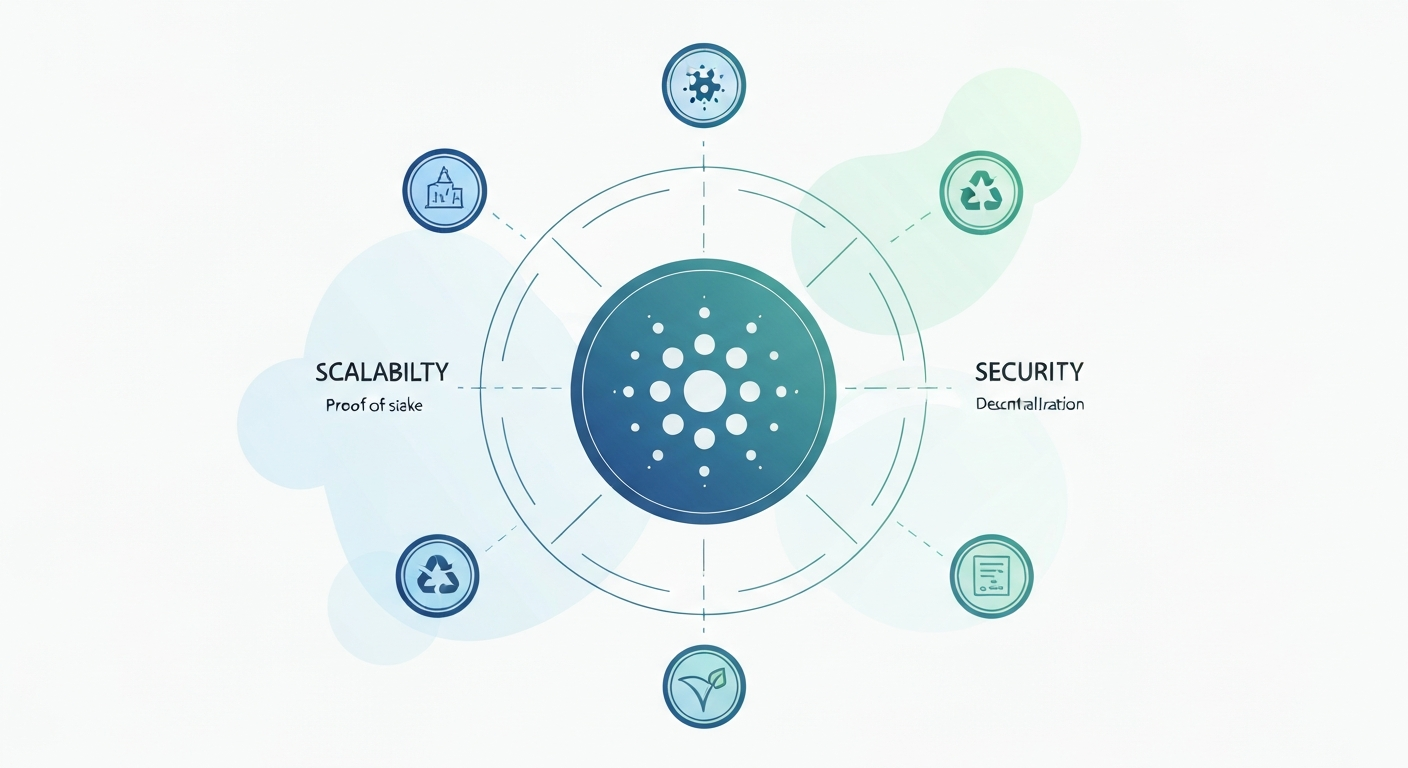
In plain terms, Cardano runs on a proof‑of‑stake (PoS) engine called Ouroboros, which was born out of [internal link: Peer-Reviewed Research] and is mathematically proven to be secure. The network is split into two layers: the Cardano Settlement Layer (CSL) handles ADA transactions, while the Cardano Computation Layer (CCL) hosts smart contracts and decentralized apps.
Think of Cardano like a modern highway system: the settlement layer is the well‑paved road for everyday traffic, and the computation layer is the set of high‑speed express lanes that let developers build complex services without slowing down regular commuters.
How It Works
- Stakeholders lock up ADA in a staking pool, signalling trust in the network.
- Ouroboros randomly selects pool operators to create the next block, based on the amount of stake they control and a verifiable random function.
- Once a block is proposed, the network validates the transactions using cryptographic proofs and adds the block to the ledger.
- Rewards are distributed proportionally to all participants who helped secure the block, encouraging long‑term participation.
- The two‑layer design ensures that transaction throughput on the settlement layer never interferes with complex contract execution on the computation layer.
Core Features
- Ouroboros PoS: A provably secure, energy‑efficient consensus algorithm derived from academic research.
- Layered Architecture: Separates value transfer (CSL) from smart‑contract logic (CCL) for better performance.
- Formal Verification: Uses Haskell and the Plutus language to mathematically verify contract correctness, reducing bugs.
- Interoperability: Built‑in side‑chain support and cross‑chain bridges enable communication with other blockchains.
- Governance Treasury: A decentralized fund where ADA holders vote on protocol upgrades and ecosystem grants.
- Scalability Roadmap: Upcoming Hydra layer‑2 solution aims to push throughput to 1 million transactions per second.
Real-World Applications
- Atala PRISM: A digital identity platform used by the Ethiopian government to give 5 million citizens verifiable IDs.
- Vidalytics: An agricultural supply‑chain tracker that records crop provenance on Cardano, reducing fraud by 30% according to a 2025 pilot.
- Marlowe Finance: A DeFi suite offering low‑fee lending and stablecoin issuance, currently handling $120 million in assets.
- Cardano NFT Marketplace: Hosts over 300 k unique NFTs, with a total sales volume exceeding $45 million in 2025.
- IOG Education Initiative: Provides blockchain‑based certificates for 200 k students across Southeast Asia.
Comparison with Related Concepts
Cardano vs Bitcoin: Cardano uses PoS, consuming less than 0.01% of the electricity Bitcoin’s PoW requires, while Bitcoin focuses solely on a store‑of‑value use case.
Cardano vs Ethereum: Both support smart contracts, but Cardano emphasizes formal verification and a layered design, whereas Ethereum relies on a single‑layer architecture and moves toward PoS with Ethereum 2.0.
Cardano vs Solana: Solana achieves high throughput via a novel proof‑of‑history mechanism, yet Cardano prioritizes provable security and academic rigor, aiming for sustainable scalability through Hydra.
Risks & Considerations
- Governance Uncertainty: Future treasury proposals could shift network priorities in ways that don’t align with all stakeholders.
- Competition: Rapid advances from other PoS platforms may eclipse Cardano’s feature set if adoption lags.
- Technical Complexity: The layered architecture and formal methods raise the learning curve for developers accustomed to Solidity.
- Regulatory Exposure: As ADA is used in more DeFi products, it may attract heightened scrutiny from regulators.
- Market Volatility: ADA’s price can swing dramatically, affecting the economic incentives for staking and participation.
Embedded Key Data
As of Q1 2026, Cardano’s market capitalization sits at roughly $12.4 billion, according to data from CoinGecko.
A 2025 academic study measured Ouroboros’ throughput at around 250 transactions per second, showing a 20% improvement over its 2023 baseline.
Frequently Asked Questions
What is Cardano’s native token?
The native cryptocurrency of the Cardano network is called ADA, named after Ada Lovelace, a 19th‑century mathematician often credited as the first computer programmer.
How does Cardano differ from other proof‑of‑stake blockchains?
Cardano’s PoS protocol, Ouroboros, is built on peer‑reviewed cryptographic research and includes provable security guarantees, whereas many other PoS chains rely on less‑formalized designs.
Can I use Cardano for Decentralized Finance (DeFi) applications?
Absolutely. Cardano hosts a growing DeFi ecosystem, including lending platforms, stablecoins, and decentralized exchanges, all leveraging the CCL for smart‑contract execution.
Is staking ADA profitable?
Staking rewards typically range from 4% to 6% annually, depending on pool performance and network parameters. Returns are paid in ADA and compound automatically.
What is the roadmap for Cardano’s scalability?
The upcoming Hydra layer‑2 protocol aims to boost transaction capacity to millions per second, while side‑chain solutions are already being piloted for niche use cases.
Summary
Cardano (ADA) is a research‑driven, proof‑of‑stake blockchain that separates settlement from computation to deliver secure, scalable smart contracts. Its emphasis on formal verification and layered design makes it a compelling platform for DeFi, identity, and supply‑chain solutions, while ongoing upgrades like Hydra keep it relevant in the fast‑moving crypto landscape.
For deeper insight, explore related concepts such as [internal link: PoS], [internal link: Ouroboros], and [internal link: Smart Contract].