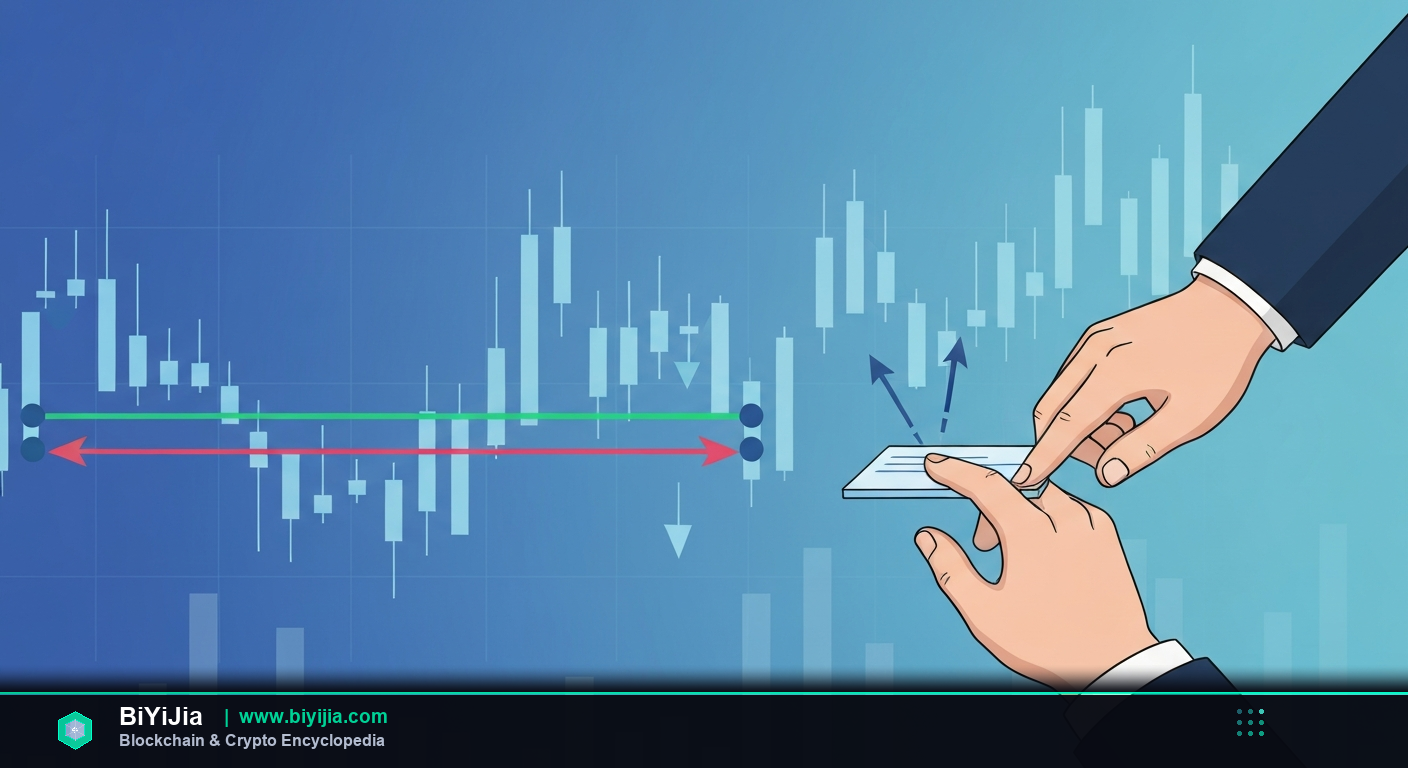

Margin refers to borrowing funds to amplify a crypto trade, letting you control a larger position than your own capital would allow.
Key Takeaways
- Margin is borrowed capital used to increase exposure in a trade.
- Leverage ratios determine how much you can multiply your position.
- Platforms like Binance, Bybit, and dYdX let you trade with crypto margin.
- Unlike traditional margin accounts, crypto margin is often unregulated and fully on‑chain.
- High leverage brings high reward potential but also a heightened risk of liquidation.
What Is Margin?
Margin is the collateral you lock up to borrow additional crypto for a larger trade.
When you open a margin position, the exchange or protocol lends you the extra assets at a predefined interest rate, and you repay the loan plus fees when you close the trade.
Think of it like a pawn shop: you hand over an item of value, get cash in return, and later repay the cash plus a fee to retrieve your item.
How It Works
- Deposit crypto as collateral into a margin account.
- Select a leverage level, such as 5x or 20x, which determines the loan size relative to your collateral.
- The platform extends the loan, allowing you to place a trade that exceeds your own balance.
- If the market moves against you, the system monitors the Maintenance Margin threshold.
- When the collateral falls below that threshold, a margin call or automatic liquidation occurs.
Core Features
- Leverage Ratio: The multiple of exposure over collateral, e.g., 10x means ten times the buying power.
- Maintenance Margin: The minimum equity percentage required to keep the position open.
- Margin Call: A notification that you must add more collateral or reduce exposure.
- Liquidation: Automatic closing of the position when collateral can no longer cover losses.
- Interest Rate: The cost of borrowing, typically expressed as an annual percentage rate (APR).
- Cross vs Isolated Margin: Cross uses all available balance as collateral; isolated limits risk to a single position.
Real-World Applications
- Binance Futures – Offers up to 125x crypto margin on major pairs; daily volume exceeded $30 billion in Q4 2025 (Binance Report).
- Bybit – Provides isolated margin with a 100x cap; over 2 million active margin traders in 2024 (Bybit Analytics).
- dYdX – Decentralized margin trading on Ethereum; average leverage of 5x across its perpetual contracts in 2025 (dYdX Quarterly).
- Kraken Margin – Traditional exchange offering up to 5x on Bitcoin and Ethereum; reported a 12% increase in margin trading revenue YoY 2025 (Kraken Financials).
- Aave v3 – Enables crypto margin borrowing via flash loans, allowing traders to open leveraged positions without upfront collateral (Aave Docs).
Comparison with Related Concepts
Margin vs Leverage: Margin is the collateral you post; leverage is the ratio that tells you how much extra buying power you get.
Margin vs Maintenance Margin: Margin is the initial deposit, while Maintenance Margin is the safety net that must stay intact to avoid liquidation.
Margin vs Margin Call: A margin call is a warning that your posted margin is slipping below the maintenance level.
Risks & Considerations
- Liquidation Risk: Rapid price swings can wipe out your collateral, especially on high leverage.
- Interest Accrual: Borrowed funds accrue fees; prolonged positions can erode profits.
- Counterparty Risk: Centralized platforms may face solvency issues; DeFi protocols can be vulnerable to smart‑contract bugs.
- Market Volatility: Crypto markets are notoriously volatile, amplifying both gains and losses.
- Regulatory Uncertainty: Many jurisdictions are still defining rules around crypto margin, which could affect platform availability.
Embedded Key Data
According to the 2025 Crypto Derivatives Report, global crypto margin trading volume reached $1.2 trillion, a 38% rise from 2023 (CoinMetrics).
A recent survey by the Blockchain Association showed that 64% of active crypto traders use margin at least once a month, highlighting its mainstream adoption (BFA 2025).
Frequently Asked Questions
What is margin trading?
Margin trading lets you borrow assets to increase your market exposure. You lock up crypto as collateral, borrow additional funds, and trade a larger position than your own capital would permit.
How does crypto margin differ from traditional margin?
Crypto margin often operates 24/7 on global exchanges, can be fully on‑chain, and typically offers higher leverage ratios. Traditional margin is usually limited to market hours and regulated environments.
What happens if my position is liquidated?
The platform automatically sells enough of your collateral to cover the loan and fees. Any remaining assets return to you, but you may lose a substantial portion of your original deposit.
Can I use margin on decentralized platforms?
Yes. Protocols like dYdX and Aave enable on‑chain margin borrowing, often using smart contracts to enforce liquidation rules without a central intermediary.
Is margin trading suitable for beginners?
Margin amplifies risk, so newcomers should start with low leverage, practice on testnets, and fully understand liquidation mechanics before committing real funds.
Summary
Margin is the collateral that powers leveraged crypto trades, allowing you to control larger positions with a smaller capital outlay. Mastering margin requires awareness of leverage, maintenance requirements, and liquidation risks, all of which tie closely to concepts like Leverage, Maintenance Margin, and Liquidation.