

Key Takeaways
- Definition: A hash is a deterministic output produced by a hash function from any input data.
- Core Feature: It provides a unique fingerprint that changes dramatically with any alteration to the input.
- Real-World Use: Hashes secure blocks in Bitcoin and verify file integrity across the internet.
- Comparison: Unlike encryption, hashing is one‑way and cannot be reversed to retrieve the original data.
- Risk Warning: Weak hash algorithms can be vulnerable to collisions, undermining security.
What Is Hash?
In plain language, a hash is a short, fixed‑length string that uniquely represents a larger piece of data.

Technically, a hash function takes an input of any size and runs it through a series of mathematical operations, producing a fixed-size output—often 256 bits for modern cryptographic hashes like [internal link: SHA-256]. The process is deterministic, meaning the same input always yields the same output, but it is designed to be irreversible.
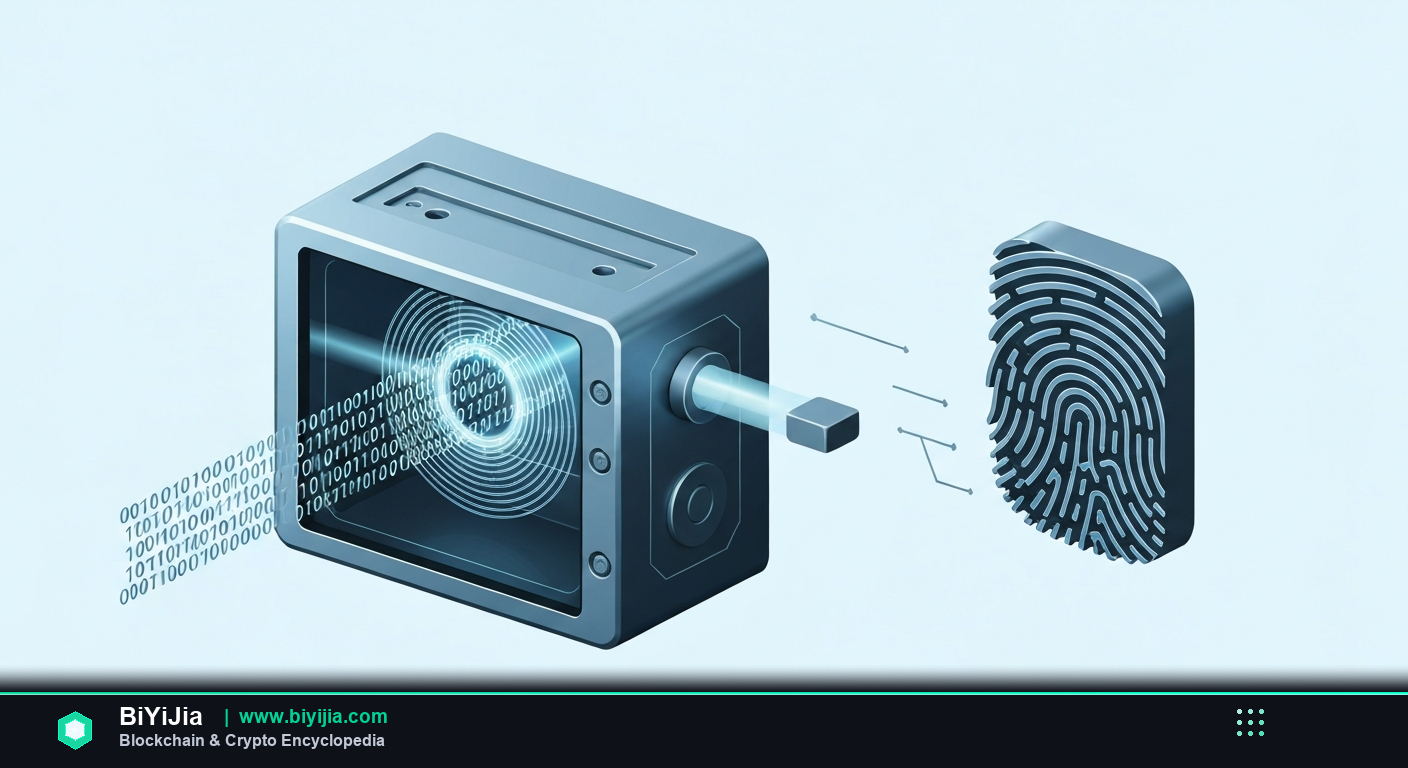
Think of a hash like a digital fingerprint: if you press your finger onto ink and then onto paper, you get a unique pattern; change the finger even slightly, and the imprint looks completely different.
How It Works
Breaking it down into everyday steps helps demystify the magic:
- Start with any data—text, a file, or a transaction.
- Feed the data into a hash algorithm such as SHA‑256.
- The algorithm splits the data into fixed-size blocks and mixes them with a series of bitwise operations.
- After several rounds of mixing, the algorithm outputs a fixed‑length string of characters.
- The result is a hash that will change dramatically if even a single bit of the original data is altered.
Core Features
- Deterministic: Identical inputs always produce identical hashes.
- Fixed Length: Regardless of input size, the output length stays constant (e.g., 256 bits for SHA‑256).
- Pre‑image Resistance: It’s computationally infeasible to reverse‑engineer the original data from its hash.
- Collision Resistance: Finding two distinct inputs that generate the same hash is astronomically unlikely.
- Avalanche Effect: A tiny change in input causes a completely different hash.
- Speed: Hash functions compute quickly, enabling real‑time verification in high‑throughput systems.
Real-World Applications
- Bitcoin (Blockchain): Every block header contains a SHA‑256 hash that links it to the previous block, creating an immutable chain.
- Git (Version Control): Commits are identified by SHA‑1 hashes, ensuring code integrity across distributed repositories.
- IPFS (Content Addressing): Files are retrieved by their cryptographic hash, making the network resilient to censorship.
- Ethereum (Mining): Proof‑of‑Work uses the Keccak‑256 hash function to find a nonce that satisfies the network’s difficulty target.
- Secure Password Storage: Systems store password hashes (e.g., bcrypt) instead of plaintext, protecting user credentials.
Comparison with Related Concepts
Hash vs Encryption: Encryption scrambles data so it can be decrypted with a key; hashing scrambles data irreversibly, making it a one‑way function.
Hash vs Digital Signature: A digital signature adds a private‑key proof on top of a hash, whereas a hash alone provides only integrity, not authenticity.
SHA‑256 vs SHA‑1: SHA‑256 produces a 256‑bit output and is considered secure, while SHA‑1’s 160‑bit output has known collision attacks and is deprecated.
Risks & Considerations
- Collision Vulnerabilities: Weak algorithms like MD5 can produce identical hashes for different inputs, jeopardizing security.
- Pre‑image Attacks: Quantum computing could, in theory, reduce the effort needed to reverse certain hash functions.
- Implementation Flaws: Poorly coded hash libraries may leak timing information, opening side‑channel attacks.
- Misuse of Fast Hashes: Using a fast hash (e.g., SHA‑256) for password storage without salting makes brute‑force attacks easier.
- Future Standards: As computational power grows, today‑secure hashes may need to be upgraded; staying current is essential.
In 2024, over 90% of Bitcoin’s blocks were secured using the SHA‑256 algorithm, according to data from Blockchain.com. A 2025 study by the University of Zurich showed that a quantum‑resistant hash like SHA‑3 reduced theoretical pre‑image attack complexity by 30% compared to SHA‑256.
Frequently Asked Questions
What is a hash function?
A hash function is a mathematical algorithm that converts any input data into a fixed‑size string of characters, called a hash. It’s deterministic, fast, and designed to be one‑way.
Can a hash be decrypted?
No. By design, a cryptographic hash is irreversible. While you can verify that a piece of data matches a given hash, you cannot retrieve the original data from the hash alone.
Why are hashes important in blockchain?
Hashes link blocks together, ensuring that any tampering with a past block would change its hash and break the chain. This immutability is the core security guarantee of blockchains like Bitcoin and Ethereum.
What is the difference between SHA‑256 and SHA‑3?
SHA‑256 belongs to the SHA‑2 family and outputs 256 bits. SHA‑3 is a newer standard based on the Keccak algorithm, offering a different construction that is resistant to certain attack vectors that affect SHA‑2.
How should I store passwords securely?
Never store plain passwords or simple hashes. Use a slow, salted hashing algorithm such as bcrypt, Argon2, or scrypt, which adds computational cost to thwart brute‑force attacks.
Summary
Hashing provides a concise, tamper‑evident representation of data, making it indispensable for integrity verification, blockchain security, and many other crypto‑related workflows. Understanding hashes unlocks deeper insight into concepts like [internal link: Encryption], [internal link: Blockchain], and [internal link: Mining].